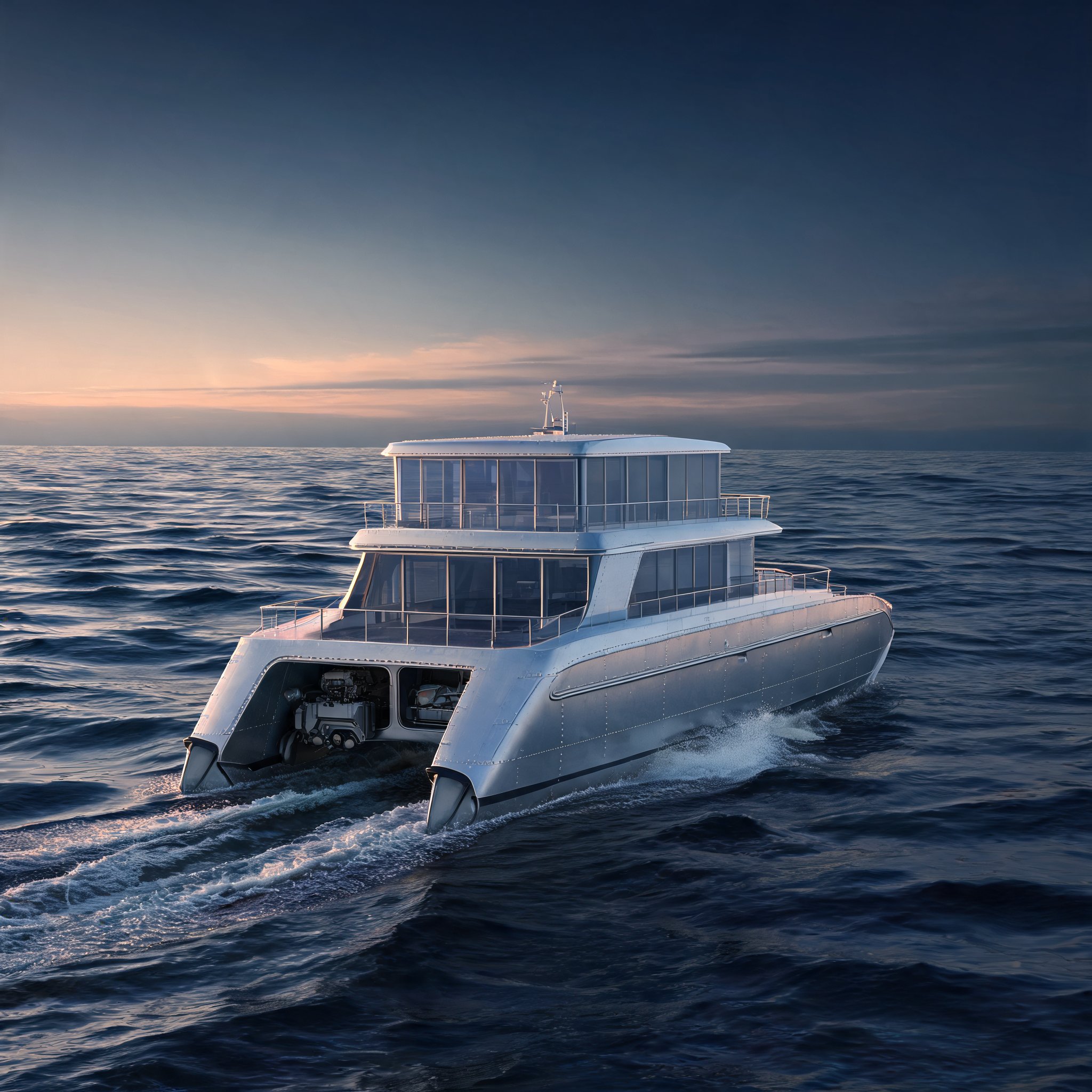
Bering Yachts has presented the first hull of its BC60 aluminium explorer catamaran, extending the yard's long-range explorer approach onto a twin-hull platform. The 18.9-metre vessel has already been delivered and is afloat, and founder and CEO Alexei Mikhailov provided a detailed walkthrough of its design and onboard systems.
Dimensions and long-range capability
The BC60 measures 18.9 metres overall (60 feet) with an 8.6-metre beam and draws 1.58 metres. Bering positions it as a displacement explorer rather than a high-speed production catamaran: the all-aluminium hull, shallow draft and substantial fuel capacity are intended to support extended passages and greater autonomy at sea.
Fuel capacity exceeds 13,500 litres, which the yard says gives a range of more than 3,500 nautical miles at a cruising speed of 8 knots. Fresh-water capacity is approximately three cubic metres, while the grey-water and black-water tanks hold 1,500 litres each.
Aluminium construction and machinery layout
The twin-hull configuration is arranged around the equipment and storage needed for long journeys. Unusually deep sponsons contain a two-level engine-room arrangement with accessible space for generators, watermakers, sewage-treatment equipment and other systems. Bering says the layout also helps isolate noise and vibration from the living areas. Protected running gear and attention to structural integrity are presented as part of the vessel's safety-oriented design, while the aluminium construction and resulting weight distribution allow a fully enclosed flybridge that functions as a second salon.
Accommodation and enclosed flybridge
The main deck holds a salon with a full helm station offering 360-degree visibility, and a galley arranged on both sides of the space. One sponson accommodates the master cabin, which has room to walk around the bed, panoramic windows, a walk-in wardrobe and an en-suite bathroom with a full shower. The opposite sponson contains two guest cabins, each with its own bathroom.
A dedicated crew cabin, laundry and pantry areas, additional refrigeration and extensive storage are also included, supporting long stays aboard whether the catamaran is owner-operated or run by a small professional crew. The enclosed flybridge carries a bar, refrigeration, a day bathroom and 360-degree visibility, and can be configured as a lounge, gym or office.
Designed for extended time at sea
Mikhailov said the design carried the DNA already proven on the B72 and B88 — range, reliability, quiet running and the ability to remain self-sufficient for long periods — onto a catamaran platform, describing the BC60 as a displacement exploration vessel rather than a leisure catamaran. He also highlighted low sound and vibration levels at cruising speed alongside the storage and onboard systems intended to support self-sufficiency on long passages.
The delivery and launch of the first hull put Bering's twin-hull explorer concept into practice, carrying design principles established in the B72 and B88 into a new vessel format.