Professional refrigeration is being reshaped by three pressures: food safety, energy costs and European rules on energy-related products. Blast chillers, once treated as specialized kitchen equipment, are increasingly positioned as a process and efficiency tool. The shift matters because rapid cooling sits at the intersection of microbiological control and electricity use.
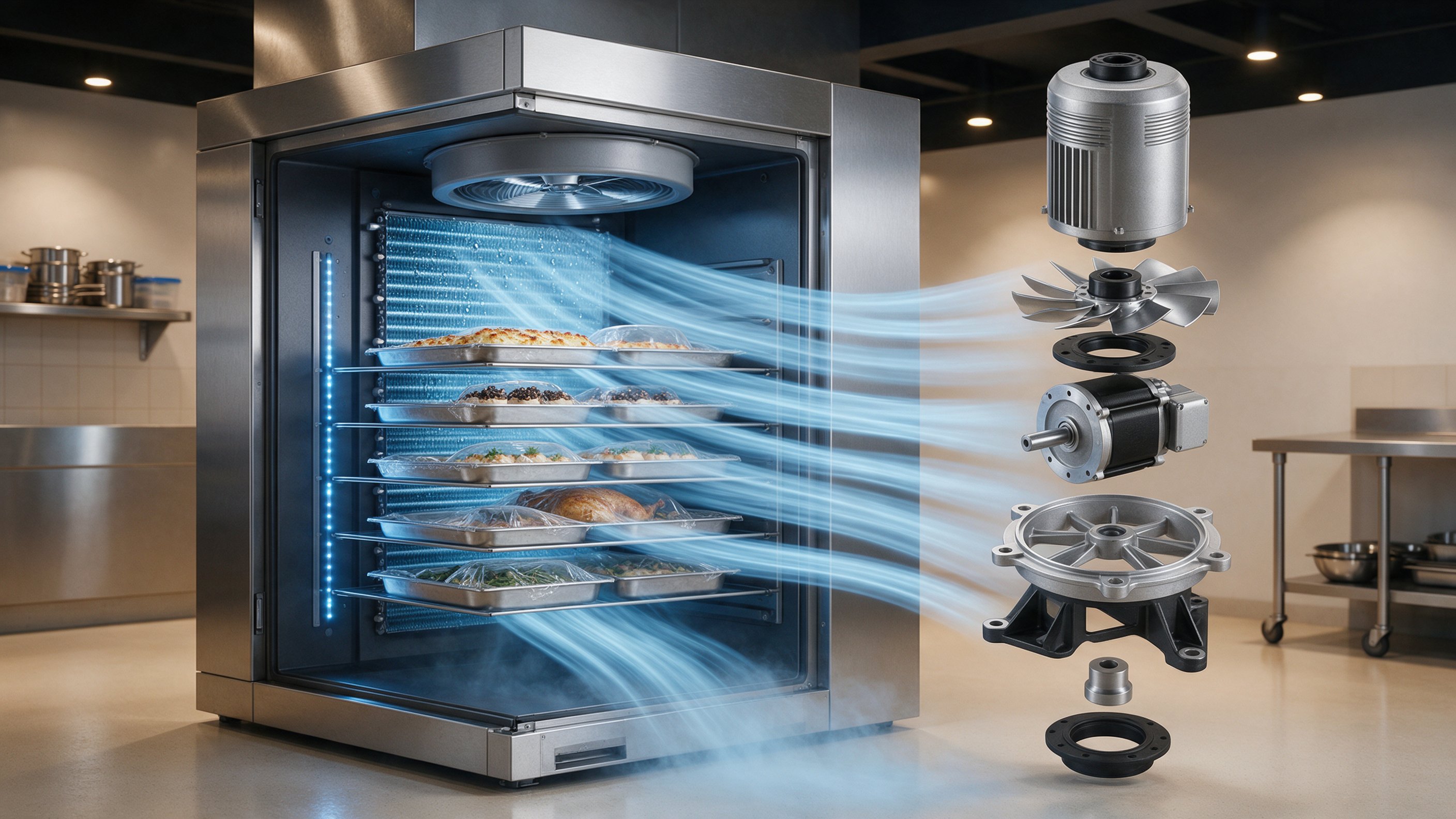
Rapid cooling works by circulating cold air intensively around food. A useful benchmark is a drop from more than 70°C to below 3°C in as little as 90 minutes. That speed is not merely a convenience. After cooking, food passes through a danger zone of roughly 63°C to 4°C, where microorganisms can multiply quickly. HACCP principles therefore emphasize reducing time spent in that range. A blast chiller shortens that window while also helping preserve texture, moisture, aroma and nutritional value. It can support production planning and reduce waste in high-volume kitchens, hospitals, hotels, catering and food processing.
Airflow, not just the refrigeration circuit
Performance discussions often start with the compressor or evaporator. The performance case rests heavily on how uniformly cold air reaches the load. Heat transfer is effective only when airflow covers the entire batch. Slow zones or turbulence can leave parts of the product cooling more slowly, creating temperature differences that affect safety, cooling time and final quality.
That makes the fan a strategic component. EC, or electronically commutated, motors combine electrical efficiency with continuous speed control, allowing airflow to match each stage of the cooling process. When paired with biomimetic impeller design and next-generation composite materials, the described result is more uniform cold-air distribution and lower energy consumption. The material also notes reduced need for large external controllers in some configurations, which can free space for food inside the chiller. These are equipment-design claims rather than independently verified outcomes, but they show where manufacturers are concentrating engineering effort.
The operational benefits extend beyond electricity. Better turbulence control can lower noise and improve working conditions, while lower heat generation can support refrigeration system performance. Because EC motors are described as operating under lower mechanical stress and with more precise control, they are linked to longer equipment service life and reduced maintenance. In a market pressured by electricity costs, such details connect directly to installation profitability.
Digital control and traceability
Digitalization adds another layer. Modern blast chillers can select programs based on food type, monitor temperature through probes and record the process for traceability. That record is useful in food-safety audits and HACCP compliance. Open protocols such as Modbus allow units to connect with kitchen infrastructure and building management systems. Remote monitoring and predictive maintenance can then use parameters such as temperature, fan speed, operating hours and energy consumption to spot deviations before they become failures.
This changes the value proposition. A blast chiller is no longer only a cooling box; it becomes a monitored process step. The implication is not that connectivity automatically delivers savings; rather, integration is presented as a way to optimize operation, improve system profitability and increase availability. The distinction matters: digital tools depend on correct commissioning, data interpretation and maintenance practices.
European rules raise the bar
The regulatory backdrop is influencing design. The European Union is pursuing more ambitious reductions in energy consumption and carbon emissions, and the Ecodesign framework is broadening beyond energy performance alone. Durability, repairability, digitalization and efficiency—of components and of whole systems—are entering the criteria. The Ecodesign for Sustainable Products Regulation, or ESPR, is presented as a turning point. Although many measures will arrive progressively, the 2026 horizon is already shaping decisions by manufacturers and engineering firms.
One consequence is that performance improvements can no longer rely only on the refrigeration circuit. Motors, fans, heat exchangers and electronic systems all affect whether a system reaches the efficiency levels the market demands. ZIEHL-ABEGG offers one example: its EC axial fans for commercial refrigeration and food service are described as combining high-efficiency motors, optimized aerodynamics, low noise and communication through open protocols. The example illustrates a broader pattern: equipment makers are collaborating more closely with ventilation, motor and control specialists.
A system-level challenge for the supply chain
The shift also redefines roles. Manufacturers must keep investing in equipment that can meet tighter rules. Installers and engineering firms need broader expertise in electronics, connectivity and control systems, because customers are asking not only for cooling capacity but for lower operating costs and high reliability. If intelligent components, remote monitoring and predictive maintenance become standard, installation professionals may act more like technology advisors across the equipment lifecycle.
For operators, the practical lesson is to evaluate blast chilling as a system. Food safety remains the primary objective, but achieving it increasingly depends on airflow uniformity, motor efficiency, digital traceability and regulatory readiness. These are connected rather than separate concerns. A faster cooling cycle can improve safety and quality; a more efficient fan and control system can reduce energy use; and open communication can support monitoring and maintenance. None of these benefits should be assumed without verification in a given installation, but together they define the design agenda.
Looking ahead, professional refrigeration is moving toward equipment that is more efficient, intelligent and sustainable. Blast chillers are a clear example because they combine food safety, automation and energy performance in one process. The fan, once a secondary component, becomes a strategic element affecting airflow, cooling uniformity, energy consumption and acoustics. The next generation of commercial refrigeration will still need to produce cold effectively. The difference is that it will be expected to do so with lower energy use, greater connectivity and enough flexibility to meet emerging environmental and regulatory demands.