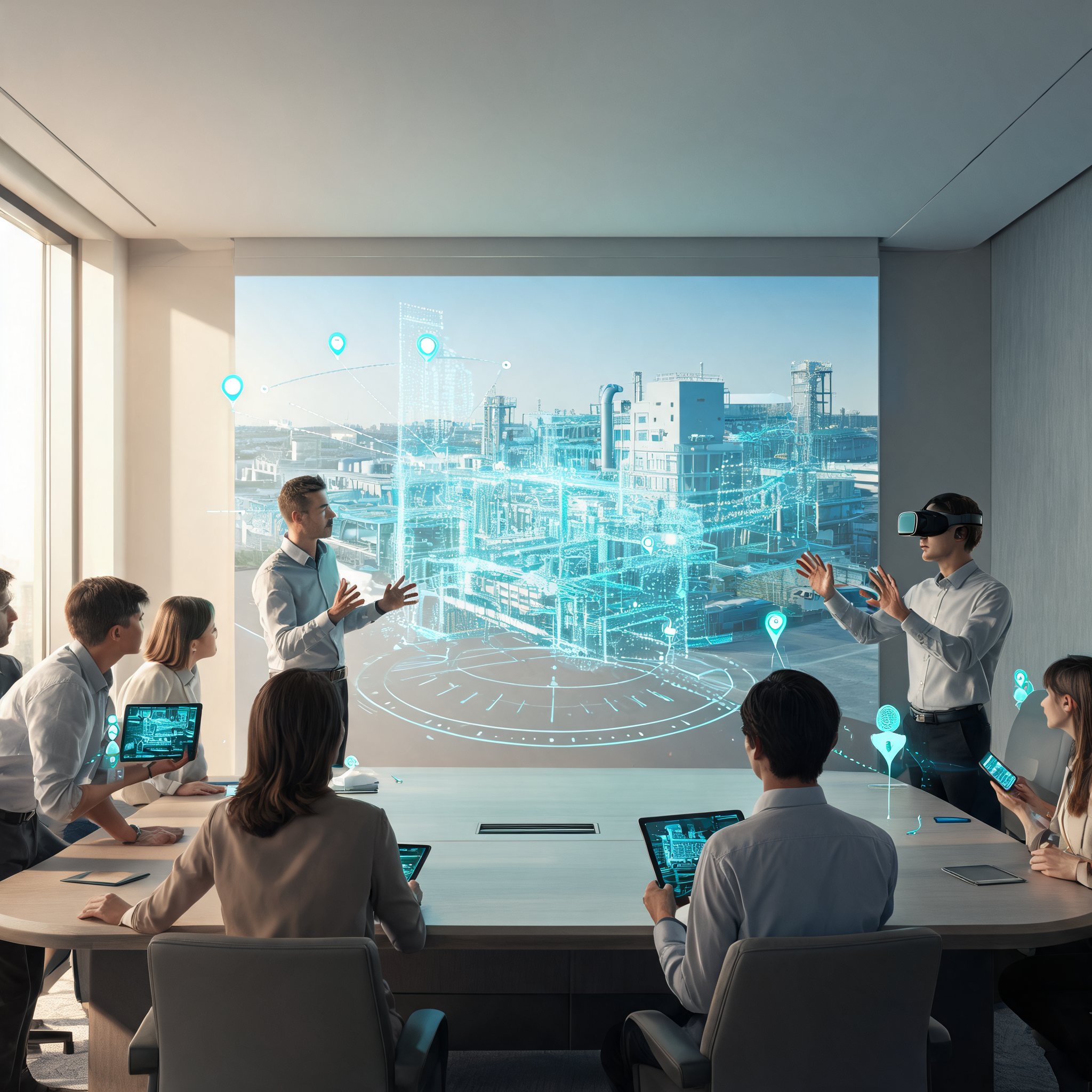
Cintoo has introduced Cintoo Workspace, a collaboration application that lets project teams meet inside high-fidelity digital twins streamed directly from 3D scan data. The company said users can join a real-time review session from a desktop, a VR headset or an immersive room, and that built-in guided collaboration is intended to give virtual reviews the structure of a site walk.
Cintoo frames the launch around a gap in reality-capture workflows: organizations are capturing more reality data, but the people who need to review it are seldom in the same place. Cintoo describes current alternatives as either unstructured meetings in shared 3D spaces, where participants can lose track of one another, or video calls in which the group watches a single low-resolution, screen-shared walkthrough. Decisions then migrate to email, additional meetings and costly site visits.
Scan data first, with BIM and CAD alongside
Workspace is an Unreal Engine application connected through the cloud to the Cintoo platform. According to Cintoo, it works with scan data captured by terrestrial scanners, mobile scanners, 360-degree cameras and drones, as well as with BIM or CAD models. That combination is meant to let teams review a site as it actually is and compare existing conditions with the design.
The product’s focus differs from collaboration tools built primarily around design models. Cintoo is positioning Workspace around captured reality data, while still allowing design information to be viewed alongside it.
Guided sessions and shared tools
Workspace’s guided collaboration is modeled on how teams move through a physical site. One person leads the review. Participants can choose to follow the leader while remaining free to explore, and the leader can bring the group to a specific location when something requires attention. Role indicators, avatars and a radar are included to help users stay oriented.
Shared annotations, measurements and issue features are intended to keep decisions inside the digital twin, according to Cintoo. The company says this structure is meant to make remote reviews more effective than simply placing users in the same 3D space.
Campbell: structure matters
Dace Campbell, Cintoo’s product and business manager for XR and metaverse, said that being in the same 3D environment is not the same as working together. He said teams need the structure of a real site walk: someone leads, people can break off to check details, and everyone regroups to discuss. Campbell added that carrying out that process in real scan data, on each participant’s preferred device, is what makes remote reviews work and, from Cintoo’s perspective, can support faster and more confident decisions.
In the workflow described by Cintoo, the digital twin becomes a shared meeting place where a distributed group can examine existing conditions, compare them with design intent, annotate findings and discuss issues in context. The approach depends on organizations having suitable scan data and models, and on participants having access to a supported device or environment.