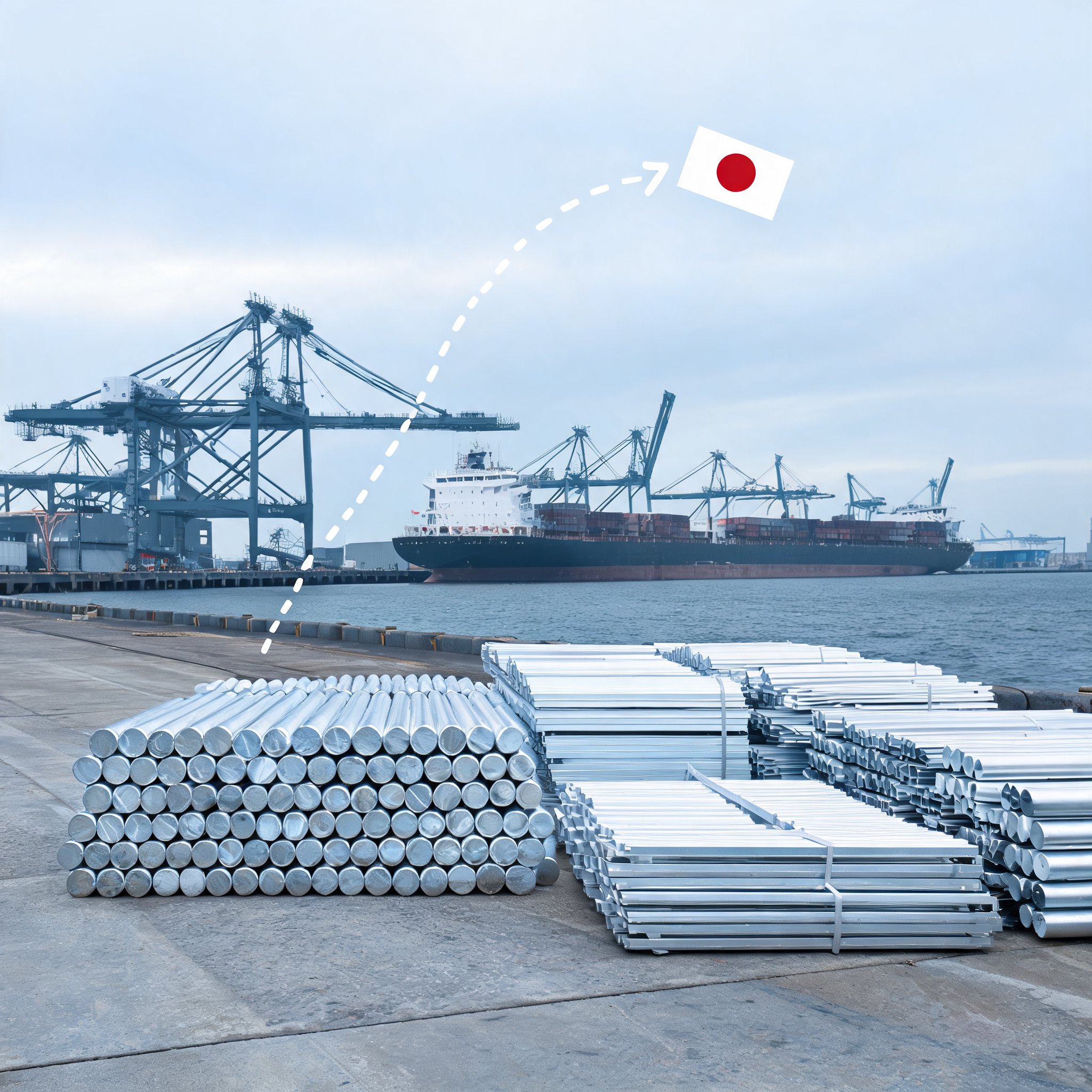
Japan imported 1.36 million tonnes of downstream aluminium products in January–August 2026, down 6.2% from 1.45 million tonnes in the same period of 2025, according to the latest import figures. The total was about 90,000 tonnes lower year on year. Annual imports had been broadly stable over the previous three years, rising from 2.11 million tonnes in 2023 to 2.12 million tonnes in 2024, an increase of 0.3%, and edging up another 0.1% in 2025 to 2.12 million tonnes.
The latest comparison covers five leading suppliers: the UAE, Australia, Brazil, China and Malaysia. It shows lower overall volumes and a change in their ranking, with the UAE recording the largest decline in shipments among the five and Australia becoming the top supplier in the listed group.
UAE shipments and spending fall
The UAE was Japan’s largest supplier among the five countries listed in January–August 2025, but fell to second place in January–August 2026. Shipments declined from 269,815 tonnes to 157,022 tonnes, a fall of 41.8%. Japan’s expenditure on imports from the UAE also fell, from about USD 758 million to USD 517 million, a decrease of 31.8%. The decline in import spending was smaller than the fall in shipment volume.
Australia becomes the largest listed supplier
Australia moved from second place in January–August 2025 to become Japan’s largest supplier among the five countries listed in January–August 2026. Imports fell from 256,366 tonnes to 236,695 tonnes, down 7.7%. Despite the lower volume, expenditure rose from about USD 710 million to USD 825 million, an increase of 16.2%. Australia’s higher import value alongside lower shipment volumes contrasted with the decline in both volume and spending recorded for the UAE.
Together, Australia and the UAE supplied about 393,716 tonnes of downstream aluminium to Japan in January–August 2026, compared with 526,182 tonnes in January–August 2025. Their combined shipments declined by 25.2%.
Brazil and China increase shipments
Imports from Brazil increased from 104,916 tonnes in January–August 2025 to 120,121 tonnes in January–August 2026, a rise of 14.5%. China recorded a stronger increase, with shipments climbing from 89,735 tonnes to 138,214 tonnes, up 54%. China moved from fifth place among the five leading suppliers in January–August 2025 to third place in 2026.
Malaysia broadly stable
Malaysia’s shipments remained almost unchanged at 115,258 tonnes, compared with 115,841 tonnes a year earlier, a decrease of 0.5%. Its ranking changed as China moved up the listed group.
Across the five suppliers, the figures show a reordering of Japan’s import rankings alongside the overall decline in volumes. China and Brazil increased shipments, while the UAE and Australia both shipped less; Malaysia was broadly stable. The combined Australia–UAE total fell sharply, reflecting the scale of the UAE decline and the smaller reduction in Australian volumes.