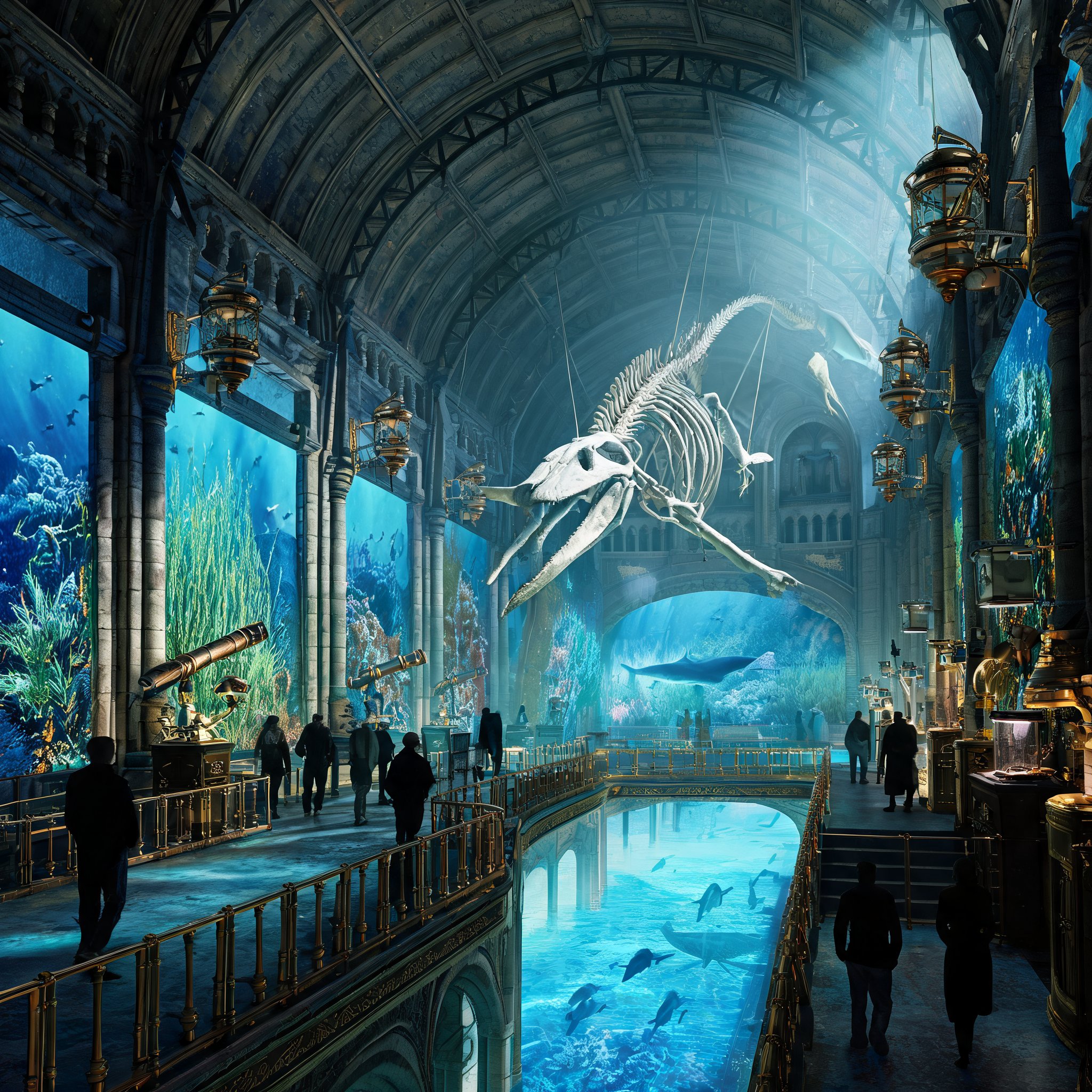
Oceano Odyssey: Mission Pelagos is the flagship experience of the Oceanographic Museum of Monaco’s Mediterranean 2050 programme. Rather than explaining the future of the Mediterranean or concentrating on environmental decline, the exhibition presents a scientifically credible vision of a Mediterranean in which long-term conservation has succeeded. The museum describes the project as a way to let visitors experience a future worth protecting.
The setting is central to the concept. The century-old Salle de la Baleine has been transformed into the interior of a scientific research vessel. Its monumental architecture, suspended marine skeletons and heritage are not hidden behind technology; they are treated as part of the narrative. Projection mapping, sound and scenography are used to reveal the architecture rather than compete with it.
A shared expedition
Visitors experience the exhibition as a group journey rather than through headsets or individual devices. Families, school groups and international audiences share the same environment. Guided by Captain Anita and her crew, they follow a scientific expedition through seagrass meadows, coral habitats, deep canyons and open waters. The route includes dolphins, fin whales, sperm whales and more than 30 Mediterranean species. The museum frames the approach as science experienced through exploration, rather than delivered only through interpretation.
Science from the start
The museum’s scientific teams were involved from the earliest stages of development and worked with designers, writers and digital artists throughout the project. Scientific knowledge did not merely validate a finished concept; it informed the narrative, the shape and behaviour of marine species, the reconstruction of habitats and the overall visitor experience. A mezzanine level introduces the museum’s Mediterranean scientific collections, creating a dialogue between contemporary digital storytelling and more than a century of research and observation.
Technology behind the illusion
The installation is fully reversible and accommodates more than 310 m² of projection mapping. It is synchronised through an integrated Medialon show control and Modulo Pi media server architecture, turning the historic gallery into a seamless narrative environment. Developed in Unreal Engine, the digital environment recreates a scientifically informed 300 km² Mediterranean ecosystem. It brings together more than 866,000 digital assets and over 30 Mediterranean species created in close collaboration with the museum’s scientific teams. According to the museum, the technical ambition should be considerable but barely noticed by visitors: technology exists to sustain the illusion, not to become the attraction itself.
The project combines heritage, science, technology and storytelling within a single design and aesthetic approach. The museum presents it as a model in which immersive design supports the institution’s educational mission, adds value to the architecture and invites visitors to see themselves as participants in the future they wish to protect.