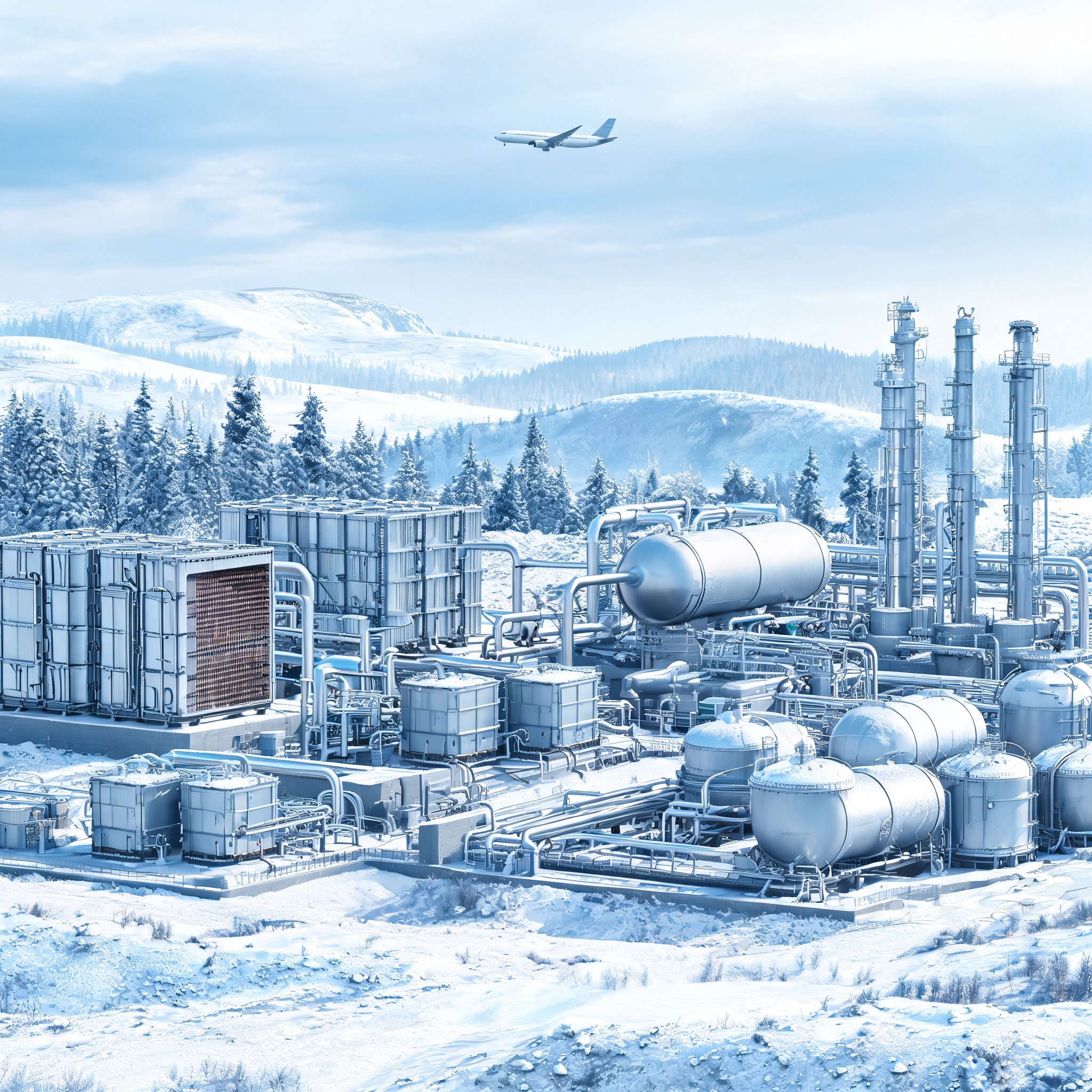
Topsoe A/S and Sasol Ltd. have signed a license and engineering agreement with Alby PtX AB for the Swedish developer’s planned e-SAF facility in Alby, Sweden. The agreement covers an integrated gas-to-liquid technology package, G2L, that combines Topsoe’s eREACT and hydroprocessing technologies with Sasol’s low-temperature Fischer-Tropsch, or LTFT, technology. The announcement describes a licensing and engineering arrangement; it does not state that the facility has been built or has begun production.
According to the companies, eREACT would enable synthetic gas production. Hydroprocessing, together with LTFT, would then upgrade synthetic hydrocarbons into aviation fuel. The integrated design is intended to support production of approximately 66,000 metric tons of e-SAF annually. Sasol said the facility would convert renewable hydrogen and captured carbon into sustainable aviation fuel. The announcement did not disclose a final investment decision, construction schedule, project cost, permit status or offtake arrangements.
Technology package
The G2L offering combines two technology streams from the two licensors. Topsoe contributes eREACT for synthesis gas production and hydroprocessing for fuel upgrading, while Sasol contributes its LTFT technology. In the proposed configuration, the units are presented as an integrated chain rather than separate process steps. The companies say the combination is intended to make efficient use of renewable power and captured carbon while maximizing aviation fuel output, according to comments from Alby PtX’s chairman.
Topsoe and Sasol said the Alby PtX agreement follows recent joint agreements with HDF Energy S.A. of France and Bharat Petroleum Corp. Ltd. of India. Those references place the Swedish project within a series of licensing arrangements for the two companies’ integrated e-fuels technology, although the announcement does not provide comparable capacity, timing or commercial terms for the earlier agreements.
Executive comments
Yassir Ghiyati, chief commercial officer at Topsoe, said scaling e-SAF production is an important step toward strengthening Europe’s energy resilience, fuel supplies and aviation decarbonization. He said the G2L offering can support Alby PtX as the project advances to its next stage of development.
Sarushen Pillay, executive vice president for business building, strategy and technology at Sasol, said the company is bringing decades of Fischer-Tropsch experience to the project. He described the role as licensing the technology and providing a licensor package, technical expertise and capabilities to support development of a facility that would convert renewable hydrogen and captured carbon into sustainable aviation fuel. Pillay said Alby PtX is an example of how proven technology and collaboration can help move sustainable aviation fuel projects toward commercial reality and support lower-carbon aviation at scale.
Andreas Schmid, chairman of the board at Alby PtX and executive director at Prime Capital AG, said Topsoe and Sasol bring an established technology partnership and experience in certified synthetic fuel production. He said the combination’s strength lies in how the technologies work together, using renewable power and captured carbon efficiently while maximizing aviation fuel output. Schmid said this provides a foundation for advancing the project and contributing to aviation decarbonization and a more resilient European fuel supply.
Project status
The agreement is a development-stage milestone for Alby PtX: it secures a technology license and engineering package from Topsoe and Sasol, but it is not an operating announcement. The project’s intended annual output of about 66,000 metric tons of e-SAF is a design target described by the technology suppliers. Further details on financing, construction, feedstock supply and fuel offtake were not included in the announcement.