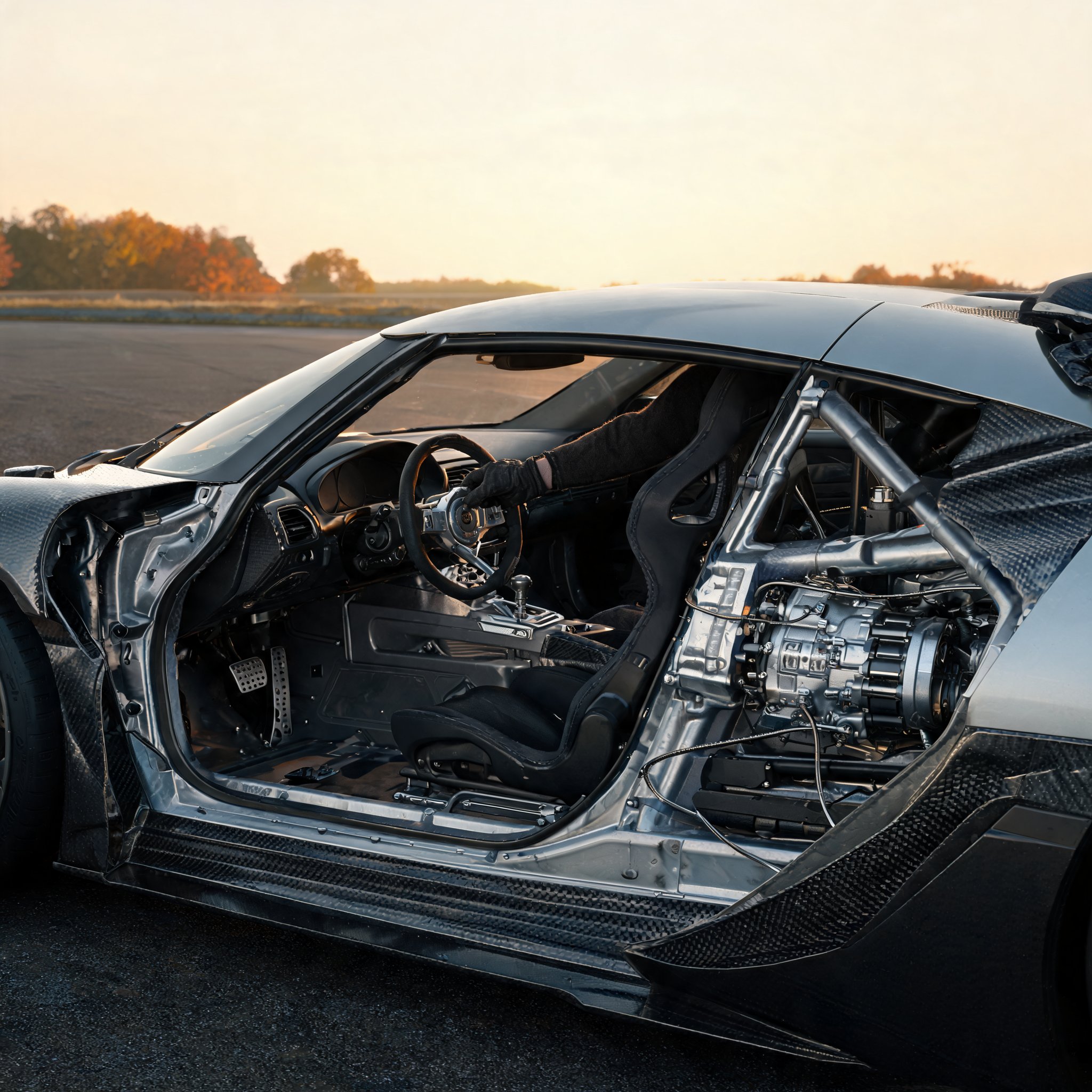
Tremec has built a manual-transaxle C8 Corvette and put a reviewer behind the wheel. The car is a one-of-one Peitz Performance race build, tested at Motorsports Gateway, a private track outside Howell, Michigan. It is not a Chevrolet production prototype and not a dealer option. It is a demonstration by a transmission supplier that a third pedal can be made to fit the mid-engine Corvette—and a reminder of why Chevrolet did not offer one in the first place.
The C8 was already a major pivot for Chevrolet. It was the first Corvette with the engine behind the driver, and the first to offer a dual-clutch automatic transmission as its only transmission. After decades of front-engine development, Chevrolet faced the cost of building two new transaxles, one manual and one automatic, for a mid-engine layout. That expense was not in GM's budget. The company chose the dual-clutch automatic, which helped the C8 win comparison tests against far more expensive cars but left manual enthusiasts without a factory option.
Tremec is a logical party to test the alternative. It supplied the six-speed manual used in GM performance models including the Blackwing cars and the discontinued Camaro. Its C8 development car uses a new manual transaxle, and the installation is more production-like than the stripped race car suggests. Peitz had to cut the tunnel to fit clutch-pedal hardware, but the gearbox occupies the same space as the stock dual-clutch unit. No exotic mating hardware was required, and the C8's pedal box has room for a clutch. The reviewer found the pedal area roomier than a last-generation Camaro's.
The shifter is the compromise
Because the C8's transmission sits behind the driver, the shifter is remotely mounted and linked by cables. That differs from front-engine cars using Tremec's TR-6060, where the shifter is mechanically connected directly to the transmission. In the C8 application, the reviewer found the action less precise and less snick-snicky, with a less notchy feel. Some drivers may prefer the smoother edges; others may miss the more mechanical feel of the front-engine layout. Moving the engine forward would produce a C7-style layout; moving the shifter rearward would put the driver's seat near the engine. Neither is a practical fix for the C8.
The test car itself was not a fair showcase for comfort or ergonomics. It had no real interior finish, a full cage and harnesses, and the selector protruding from the space normally occupied by the storage cubby and automatic gear selector. The seating position had virtually no adjustment, and the reviewer, at 5-foot-7, could not reach the floor to brace or heel-and-toe comfortably. On a green track on a November afternoon in Michigan, that kept the pace conservative. The important finding was not lap time; it was that the manual gearbox worked in a mid-engine Corvette without a fundamental redesign.
Cost is the real obstacle
The gearbox alone costs about $75,000, according to Tremec. Combined with the price of a Corvette, a manual C8 build would rival a showroom-spec Z06. That figure reflects the economics of a low-volume transaxle, not the cost of a mass-market option. Tremec says the price will fall as volume rises. It also says OEMs are interested, and not necessarily or exclusively General Motors. The gearbox was engineered to fit the C8, but other automakers have asked about a high-torque manual transaxle. No customers were named.
That interest is the most consequential part of the exercise. A manual C8 is not just an enthusiast fantasy; it is a test of whether a supplier can create a viable product for low-volume performance cars. The Corvette's mid-engine layout makes the transaxle package difficult, and the remote shifter imposes a feel penalty. The $75,000 price makes the case harder still. But the development car shows the hardware can be packaged, the clutch can be accommodated, and the driving experience is recognizably manual.
What it does not show is a production plan. The car is a race build, not a validated road car. A one-off track test does not establish durability, regulatory compliance, warranty readiness or assembly-line feasibility. The seating position was not representative, and the reviewer did not push the car to its limit. Tremec's OEM conversations may signal demand, but they do not confirm a customer or a timeline. The manual C8 remains a demonstration—an expensive, convincing one—rather than a promised showroom variant.
For manual enthusiasts, the significance is straightforward: the C8's architecture does not forbid a clutch pedal. For the industry, the question is whether enough buyers and automakers will pay for a low-volume manual transaxle to justify the tooling. Tremec has answered the engineering question. The commercial answer is still open.