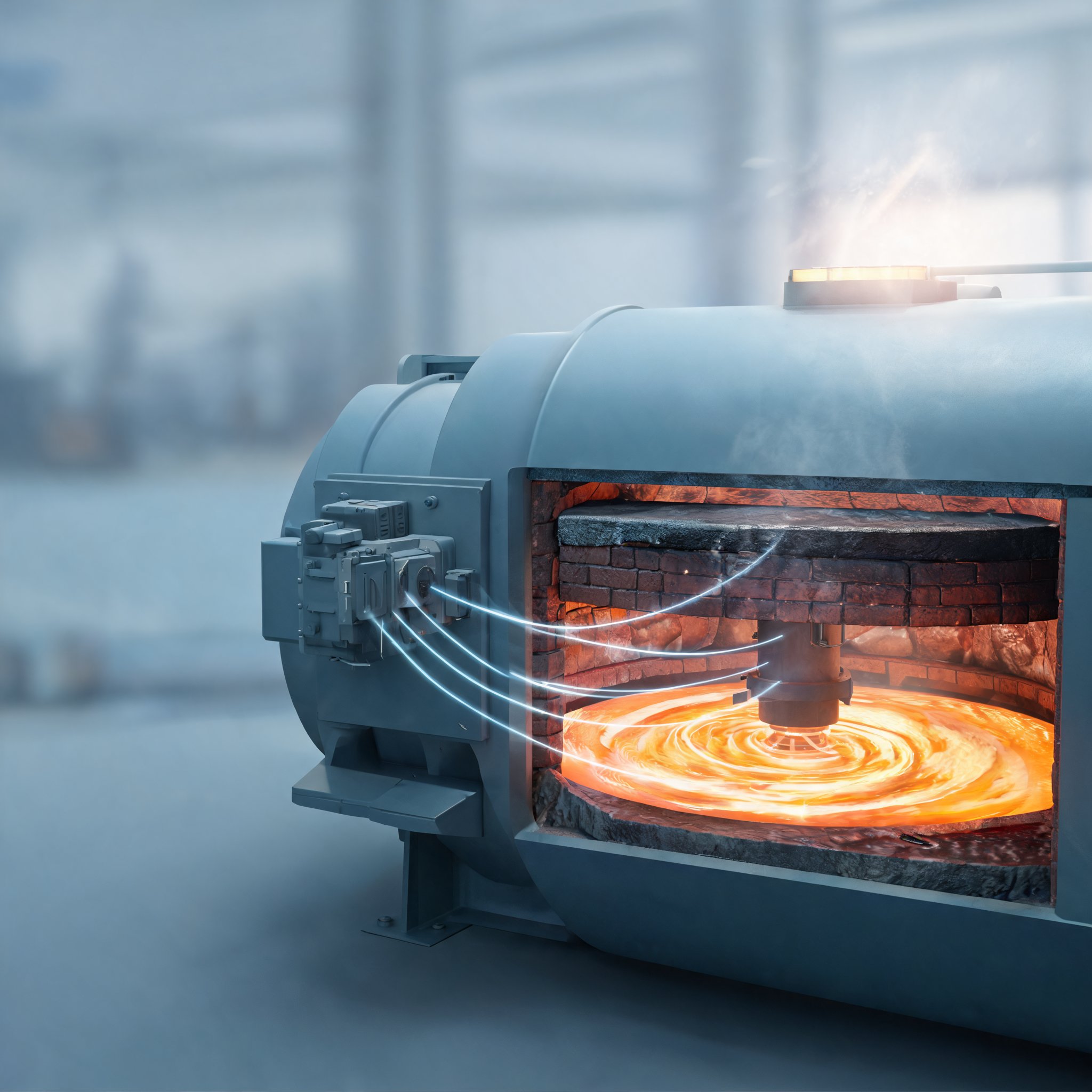
Aluminum casthouses are being asked to run more post-consumer scrap without losing melt quality, recovery or throughput, and the constraint is increasingly mechanical rather than metallurgical. Lightweight scrap, machining chips and other low-density fractions are awkward to charge into conventional melting furnaces, and getting them beneath the bath surface rather than floating and oxidizing on top has become the practical bottleneck. Zmag America, Ltd., which works on magnetic engineering for molten-metal circulation, furnace stirring and scrap recovery, is positioning a family of permanent-magnet devices against that problem.
The company's case rests on a narrow technical claim: that the metal can be moved without putting a rotating part into it.
The melting-side problem
Two requirements run in parallel. Efficient scrap feeding and submergence determine how much recycled material a furnace can absorb, while consistent temperature and chemical composition across the bath determine whether the output meets specification. Circulation and stirring equipment therefore has to support heat transfer and metal movement while limiting process interruptions and excessive metal loss.
Conventional mechanical pumps, though widely used, depend on immersed rotating components that deteriorate through exposure to molten aluminum, dross accumulation and contact with refractory debris. The maintenance burden sits inside the furnace, where access is costly and every intervention interrupts production.
A magnetic circuit instead of an impeller
Zmag traces its origins to magnetic engineering and the commercialization of eddy-current separation, used to recover non-ferrous metals from mixed material streams, before extending into molten-metal applications. Its patented zPMC (Zmag Permanent Magnetic Circuit) generates the field that moves the metal. Rather than a conventional electromagnetic stirring arrangement, the field comes from a permanent magnetic circuit, and the resulting motion is described by the company as a virtual impeller — circulation without an immersed mechanical impeller.
That is the company's characterization. No independent comparison of magnetic flux density, achievable flow rates or energy consumption against electromagnetic stirring systems is provided, so the practical difference between the two approaches remains asserted rather than measured in the available material.
Three products, three process roles
MagStir is a non-contact stirring system for melting and holding furnaces, generating movement within the bath to homogenize temperature and alloy composition. It is offered in configurations for furnaces from 15 to 200 metric tons, and because it has no immersed mechanical stirring component it adds no new moving parts to the molten-metal environment. New Zealand Aluminium Smelters installed the technology in a casting furnace and later extended it to additional furnaces; a technical case study published in 2017 reported improvements in temperature control during furnace preparation. Rio Tinto-operated Boyne Smelters in Queensland, Australia, fitted a MagStir unit to a casthouse furnace in 2019.
MagPump extends the same approach to pumping and circulation. It is designed to fit a standard pump well without furnace modification, uses no physical impeller, and is marketed as nearly hands-free, with no consumable parts and minimal downtime. At the TANDEM Division of secondary producer TST Inc. in Fontana, California, it replaced an existing mechanical pump during a seven-week trial. Reported findings describe smooth operation and reduced disturbance to the molten-metal surface, with plant management noting that the system avoided the splashing seen with conventional pumping arrangements as the furnace metal level fell during draining. The technology was presented at the TMS 2023 Annual Meeting and Exhibition in the context of side-well, multi-chamber furnaces, with gas injection and scrap submergence identified alongside metal circulation as further applications.
Typhoon addresses submergence and chip melting, introducing lightweight scrap and machining chips below the surface instead of letting them sit at the top of the bath; its magnetic circuit produces a vortex-like movement that draws material into the melt and supports heat exchange and recovery. At Neuman Aluminium's Marktl facility in Austria, the system was folded into a furnace modernization aimed at low-density post-consumer scrap, targeting fractions with a bulk density of about 375 kg/m³ that had challenged conventional charging and melting. Neuman had set a target of one metric ton per hour while continuing to melt solid charge in the same furnace; during operation the Typhoon processed almost twice the planned scrap quantity within the expected time without disrupting normal operations, with low operator involvement and no reported negative impact on melt or finished-product quality. According to the published technical account, the unit operates at 5–15 kW including its air-cooling blower, can submerge up to five metric tons per hour of machining chips, and allows vortex intensity to be adjusted so metal movement continues when scrap or alloying material is not being charged.
What the record shows, and what it does not
All three cases are company-reported or supplier-linked. They establish that the equipment has run in production casthouses across a range of furnace sizes and duties, which is a meaningful threshold for molten-metal hardware. They do not establish that it outperforms alternatives, because no comparative baselines for recovery rate, energy per tonne or campaign length are published alongside the results.
Zmag itself identifies familiarity, not performance, as the binding constraint. Eishin Takahashi, president of Zmag America, told AL Circle in August 2025 that producers globally “tend to be conservative and feel more comfortable with equipment and processes they are already familiar with,” naming limited familiarity with the technology as a barrier to wider adoption in the United States.
The competitive frame
The segment is far from empty. ABB supplies its AL-EMS electromagnetic stirring system for melting, holding and alloying furnaces and reports more than 430 installations, with an April 2026 order from Arconic for a fifth stirrer at its Hungarian casthouse following earlier units at the same facility. Presezzi Extrusion Group's Melting Technology division sells the L.E.C. (Low Energy Consumption) Stirrer for melting and holding furnaces alongside remelting equipment and complete casthouse scope. Pyrotek covers electromagnetic pumps and LOTUSS (Low Turbulence Scrap Submergence), which pairs a circulation pump with a refractory well to submerge lightweight scrap; its UK operations include EMP Technologies Ltd., which designs and installs metal-melting and circulation systems built around electromagnetic pumps. Rockwell Automation sits in adjacent automation — furnace and ladle-shop control, as in its modernization work for Mozal Aluminium — rather than offering a like-for-like permanent-magnet stirrer.
Permanent-magnet hardware is therefore one option among several, and its differentiator is the absence of immersed moving parts rather than a monopoly on non-contact circulation.
Where the relevance hinges
Whether the approach gains ground will depend on operating detail rather than principle: how light the targeted scrap fraction is, with roughly 375 kg/m³ the documented case; whether the furnace is a side-well, multi-chamber design able to accept a pump-well retrofit; the capacity band, 15–200 metric tons for MagStir; and power draw, 5–15 kW for Typhoon including its blower. For plants whose real cost is downtime and consumable parts sitting in molten metal, the trade-off is legible.
The wider question is evidential. As recycled feedstock becomes more difficult to melt, avoiding immersed mechanical components becomes a more relevant consideration — but converting that logic into standard practice requires long-campaign recovery and quality data measured against incumbent systems, which the sector has not yet put in the public record.